the short answer for GoHighLevel agencies
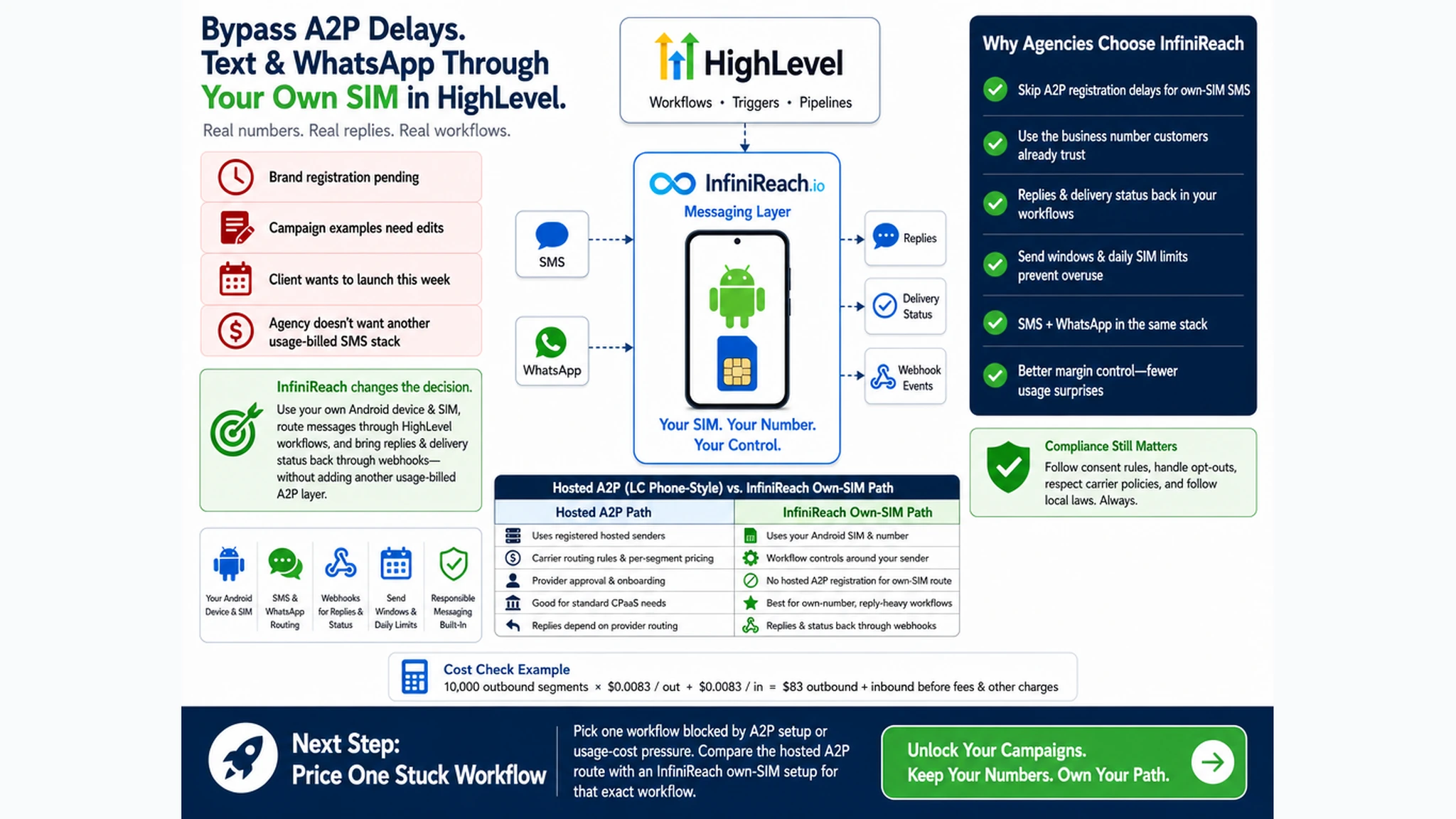
People search this query when a campaign is stuck: brand registration is pending, campaign examples need edits, a client wants to launch this week, or the agency does not want another usage-billed SMS stack inside GoHighLevel.
InfiniReach changes the decision. You can connect a real Android device and SIM, use your own sender number where that fits your consent and carrier rules, route messages through GoHighLevel workflows, and bring replies or delivery status back through webhooks. You still need responsible messaging practices. You just are not forced to make every workflow depend on the same hosted A2P path.
key takeaways
Use this page if you run GoHighLevel workflows and need a practical own-SIM SMS path, not a risky promise that compliance no longer matters.
- A2P 10DLC is a hosted long-code registration model. Twilio describes it as a way to get a verified sender identity for trusted carrier routes.
- Twilio lists US long-code SMS at $0.0083 outbound and $0.0083 inbound before carrier fees and other applicable charges.
- InfiniReach uses an Android relay app with your own SIM and number, then adds API, webhooks, send windows, and daily SIM limits on top.
- The best fit is an agency or operator that wants GoHighLevel workflows, own-number continuity, and SMS plus WhatsApp routing in one stack.
why A2P registration becomes a GoHighLevel blocker
A2P registration is not just paperwork. It changes the project timeline. The agency has to gather business details, explain use cases, prepare sample messages, wait for review, fix rejection notes, and keep clients from sending before the path is ready.
That can be worth it for some hosted-number programs. But it is painful when the workflow is local, reply-heavy, and tied to a number the business already owns. Appointment reminders, missed-call text back, lead follow-up, and reactivation campaigns often need a trusted sender and a working reply path more than they need another rented number.
The buyer behind this query is usually not trying to spam. They are trying to get a real business workflow unstuck without taking on a bill that grows every time a nurture sequence fires.
what “bypass A2P” should not mean
This page keeps the language careful on purpose. “Bypass A2P” should not mean bypass consent, carrier rules, TCPA obligations, opt-out handling, or local law. It also should not mean blasting people from a personal phone with no process.
A better frame is reducing A2P friction with an own-SIM transport path. InfiniReach can remove the hosted A2P registration step from the workflow when you send through your connected Android SIM, but the business still has to message responsibly and follow the rules that apply to its traffic.
- Do not message cold lists without consent.
- Do not hide identity or mix client senders through the wrong number.
- Do not ignore opt-outs, replies, or carrier acceptable-use policies.
- Do not promise “no compliance.” Promise a different operating model.
the cost check agencies should run first
Before changing tools, price one actual workflow. Twilio’s public US SMS pricing page lists long-code SMS at $0.0083 to send and $0.0083 to receive. It also says additional carrier fees can apply, US A2P 10DLC can involve registration onboarding fees, and a $0.001 failed-message processing fee applies only to messages ending in Failed status.
A simple 10,000-segment outbound month at $0.0083 is $83 before inbound replies, MMS, carrier fees, A2P-related costs, phone numbers, platform markup, or agency overhead. That may be fine for some teams. It becomes harder when every client subaccount, follow-up sequence, and reminder campaign adds another usage line.
InfiniReach is built for a different cost model: connect your own SIM, use plans that are easier to forecast, and keep messaging economics closer to the device and number you control. The point is not “free SMS.” The point is fewer surprise platform-metering layers between GoHighLevel and your sender.
where InfiniReach fits in the GoHighLevel stack
GoHighLevel should stay the CRM and workflow brain. InfiniReach becomes the messaging layer behind it: the connected device, sender number, channel routing, reply capture, delivery status, and operator controls.
That split gives an agency a cleaner decision. Keep pipelines, triggers, forms, calendars, and client automation in GoHighLevel. Use InfiniReach when the SMS path should come from an owned SIM and when WhatsApp belongs in the same routing plan.
- Android relay app for SMS through your own SIM and number.
- Invite or QR-based onboarding for connected devices and WhatsApp paths.
- API sends with explicit `from` and `channel` fields for sender and route control.
- Webhook events for replies and delivery status so GoHighLevel or another CRM can react.
- Send windows and daily SIM limits to prevent one workflow from overusing a sender.
compare LC Phone-style SMS with an own-SIM path
The right path depends on the job. Hosted A2P and LC Phone-style messaging can be the right fit when you want a standard provider-managed SMS channel. InfiniReach fits when sender ownership, reply continuity, and agency margin control matter more.
- Hosted A2P path: uses registered hosted senders, carrier routing rules, per-segment pricing, and the provider’s approval workflow.
- InfiniReach own-SIM path: uses your connected Android SIM and number, then adds workflow controls around that sender.
- Hosted A2P path: good for teams that want the classic CPaaS model and are comfortable with its setup and usage billing.
- InfiniReach own-SIM path: better for agencies that already have client numbers, need replies in workflows, and want SMS plus WhatsApp coverage.
- Both paths still need consent, opt-out handling, sender discipline, and local compliance review.
best-fit workflows for this route
The own-SIM model works best when the number itself has value. If customers already recognize the local business number, replies matter, and the workflow is tied to CRM follow-up, the sender should not feel disposable.
- Missed-call text back from the business number prospects already dialed.
- Appointment reminders where replies should route to staff or a pipeline stage.
- Lead follow-up where the agency wants one sender per client or location.
- Reactivation campaigns that need send windows, daily SIM limits, and reply handling.
- WhatsApp plus SMS workflows where GoHighLevel should not depend on one channel only.
when a hosted A2P provider may still be better
InfiniReach is not the right answer for every SMS program. If you need high-volume global carrier contracts, OTP-grade infrastructure, short codes, or a fully provider-managed compliance program, a traditional CPaaS route may be the better fit.
It is strongest when the business wants operational control: own SIM, own number, GoHighLevel workflows, SMS plus WhatsApp, and a real reply path. If that is the job, the own-SIM route is worth pricing before another hosted-number rollout.
next step: price one stuck workflow
Pick one GoHighLevel workflow that is blocked by A2P setup or by usage-cost pressure. Write down the sender, monthly segments, reply path, opt-out handling, send window, and whether WhatsApp should be available. Then compare the hosted A2P route with an InfiniReach own-SIM setup for that exact workflow.
If the workflow depends on a number the business already owns, needs replies to reach the team, and should not become another per-segment margin leak, InfiniReach is the route to test.