affordable SMS API solutions: the short answer
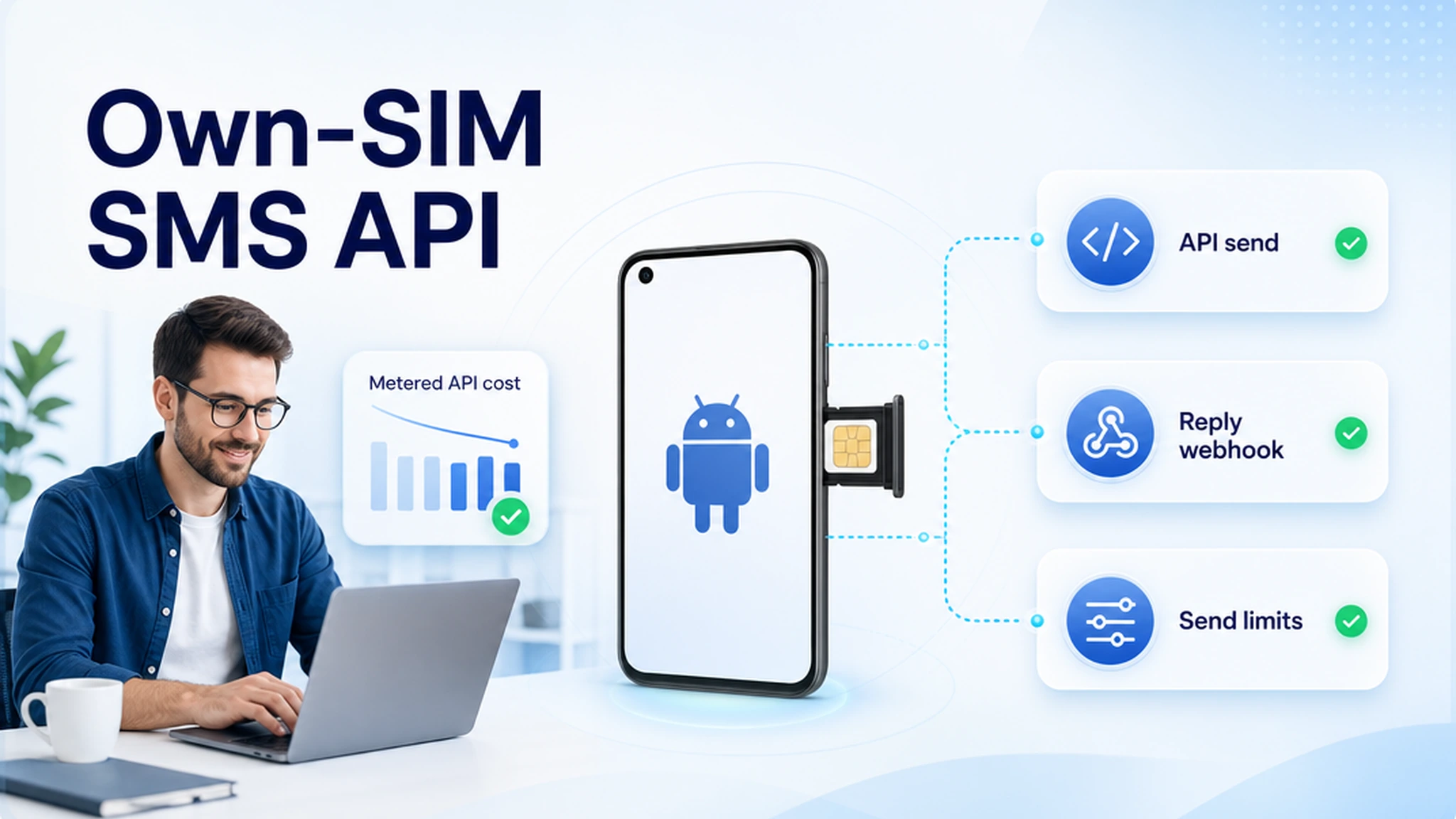
A hosted SMS API can look affordable at the first send. Twilio currently shows US long-code SMS at $0.0083 outbound and inbound per segment. Plivo lists US long-code SMS at $0.0077 outbound and inbound per SMS. Telnyx lists US SMS at $0.004 per message part plus carrier fees. Those rates are useful benchmarks, but they still meter every workflow.
InfiniReach changes the cost question. Your CRM, backend, n8n workflow, Make scenario, Zapier step, or spreadsheet script can call InfiniReach, and SMS can go out through a connected Android phone and SIM that belongs to the business. You still need a phone plan, consent, and responsible sending. You do not turn every permissioned reminder, reply, and follow-up into another InfiniReach per-message platform fee.
key takeaways
Use this page when the buyer decision is not “which API is cheapest?” but “which messaging model keeps sender trust and margin under control?”
- Metered SMS APIs are simple to start, but the bill grows with segments, inbound replies, carrier fees, sender costs, and registration work.
- InfiniReach lets teams keep API-based sending while using their own Android phone, SIM, and number for SMS delivery.
- The concrete mechanisms are Android relay setup, explicit API from/channel routing, reply/status webhooks, send windows, and daily SIM limits.
- SMS plus WhatsApp can live in the same operating layer when a workflow needs channel choice or fallback.
- Own-SIM messaging is not a compliance bypass. It still needs consent, sender discipline, and local carrier/legal review.
why teams search for affordable SMS API solutions
Most teams reach this search after a real bill or a real workflow problem. A lead form started sending hundreds of follow-ups. Appointment reminders became daily volume. A review-request workflow expanded to ten agency clients. Replies started landing in the wrong place. The original “cheap SMS API” now has costs around it.
Buyers are deciding whether to keep a hosted CPaaS provider, find a lower-rate provider, or move known workflows onto a sender they control. That is where InfiniReach belongs.
A metered API solves procurement and telecom abstraction. InfiniReach solves a narrower agency/operator problem: keep the business number, use API calls, capture replies, route status events, and protect margin on recurring, permissioned messaging.
public pricing benchmarks to check before switching
Twilio’s public US SMS pricing page lists long-code SMS at $0.0083 outbound and $0.0083 inbound per segment. The page also describes carrier fees, A2P 10DLC registration/onboarding costs, and a $0.001 failed-message processing fee.
Plivo’s public SMS pricing page lists US long-code SMS at $0.0077 outbound and $0.0077 inbound per SMS, with carrier surcharge fees shown separately. Telnyx lists US SMS at $0.004 per message part plus carrier fees.
Hosted telecom infrastructure costs money. The problem is fit. If your agency sells fixed retainers and runs repeatable local workflows, a cents-per-segment API can become a margin tax even when the advertised rate looks small.
worked example: one recurring client workflow
Say one agency client sends 18,000 outbound SMS segments per month and receives 2,500 inbound reply segments from reminders, missed-call text back, and review requests. At Twilio’s $0.0083 US long-code benchmark, base segment usage is about $170.15 before carrier fees, number costs, registration/campaign costs, failed-message fees, and the work needed to keep replies useful.
Across eight similar clients, the base segment line alone is about $1,361.20 per month before extra cost drivers. That meter eats margin as usage rises.
With InfiniReach, the client can connect an Android phone and SIM and use InfiniReach as the API and workflow layer around that sender. The agency still budgets for phone service, hardware, and InfiniReach software. The difference is that the repeat workflow is priced around an owned sender path instead of a separate InfiniReach platform fee on every message segment.
where InfiniReach fits in the API stack
InfiniReach sits between the system that decides to message and the sender that delivers the message. Your app, CRM, GoHighLevel workflow, n8n flow, Make scenario, Zapier step, or Google Sheets script sends the message request. InfiniReach handles the sender, channel, message record, replies, and status events.
For developers, the important difference is control. A workflow can pass sender and channel decisions into InfiniReach instead of hiding delivery behind one generic send action. That matters when each client needs the right SIM, sender, or WhatsApp path.
- Android relay app for SMS through a connected phone and SIM.
- Invite or QR onboarding for device and WhatsApp setup paths.
- API sending with explicit from and channel decisions.
- Webhook events for inbound replies and delivery status.
- Send windows and daily SIM limits to keep automated sends controlled.
metered SMS API vs InfiniReach own-SIM API layer
This is the practical comparison. A lower-rate SMS API still leaves you in a hosted, metered sender model. InfiniReach is a better fit when the business already has a usable number, the workflow is permissioned, and the team wants replies and sender ownership inside its CRM operations.
- Hosted SMS API: good for global coverage, OTP programs, short codes, provider-managed telecom procurement, and teams that want the carrier layer fully outsourced.
- InfiniReach: good for local or agency workflows where the sender should be a real business number and replies should land back in a workflow.
- Hosted SMS API: usually bills by segment, with carrier fees and sender or registration costs layered in by country and route.
- InfiniReach: gives API and webhook control around an owned Android SIM sender, with SMS plus WhatsApp routing when the workflow needs both channels.
- Hosted SMS API: the provider controls the sender infrastructure. InfiniReach: the operator controls the connected device, sender map, send windows, and daily SIM limits.
best-fit workflows for this model
Start with workflows where the recipient expects a message and a reply should change what happens next.
- Missed-call text back from the same business number the customer dialed.
- Appointment reminders that route confirmation replies into a CRM or calendar workflow.
- Lead follow-up from GoHighLevel, HubSpot, n8n, Make, Zapier, or a custom backend.
- Review requests and reactivation messages where an agency wants client-level sender control.
- Operational alerts where message history, delivery status, and human handoff matter.
what to avoid before moving SMS API volume
Do not treat “affordable” as permission to send more careless messages. The cheapest route will still hurt the business if contacts did not opt in, replies go nowhere, or one SIM gets pushed beyond the volume you planned.
Do not describe own-SIM sending as a way to bypass rules. InfiniReach gives operators another sender model. It does not remove TCPA, carrier acceptable-use, WhatsApp, or local compliance responsibilities.
- Do not mix clients through the wrong sender just because the API call is easy.
- Do not leave replies trapped on a device when the CRM needs to act on them.
- Do not run after-hours sends without send windows.
- Do not let retries or imports turn one workflow into an uncontrolled batch; use daily SIM limits.
when a hosted SMS API is still the better choice
Use a hosted CPaaS provider when you need global OTP delivery, short-code scale, provider-managed carrier relationships, or a telecom vendor that owns the full delivery stack. Those are real use cases, and InfiniReach is not trying to replace every one of them.
Use InfiniReach when the workflow is closer to the business: known contacts, local sender trust, agency client messaging, CRM replies, missed-call text back, SMS plus WhatsApp routing, and less variable platform spend.
how to test affordability without guessing
Pick one workflow and pull the last 30 days of data: outbound segments, inbound replies, carrier fees, sender fees, failed sends, registration or campaign costs, support time, and the hours spent chasing replies. Price that against one Android phone, one SIM plan, and the InfiniReach plan you would actually use.
If the hosted route wins because you need global reach or a short code, keep that workflow there. If the owned sender wins because trust, replies, and margin matter, move that workflow first instead of rebuilding every message path at once.
next step: price one workflow before switching
Choose one permissioned workflow with real monthly volume. Connect one Android phone and SIM, send a test message through InfiniReach, confirm the sender and channel, and route replies/status back through a webhook. Then compare one month of results against your metered SMS API bill.
If the workflow needs a recognizable number, two-way CRM follow-up, SMS plus WhatsApp coverage, and fewer variable platform fees, test InfiniReach before another metered SMS API contract.