SMS marketing benefits: the short answer
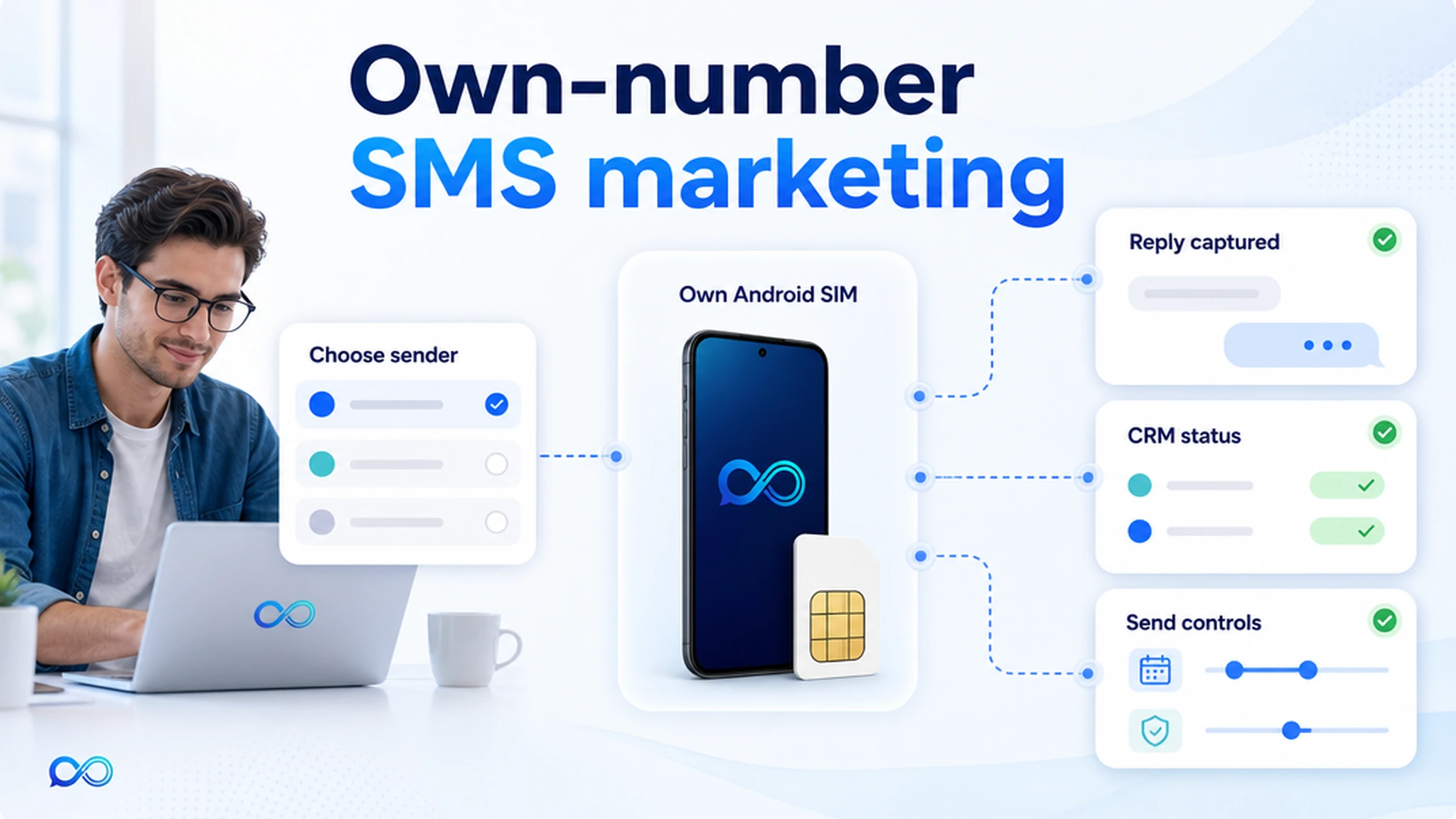
The useful benefits are not “SMS is fast” or “SMS has high open rates.” The useful benefits are operational: the message comes from a number the customer trusts, replies can be handled, the sender can be controlled, and the cost model does not surprise the agency after every campaign.
That is where InfiniReach changes the SMS marketing conversation. Your campaign or workflow can send from an Android phone and SIM you control, route SMS plus WhatsApp, and push replies or delivery status back into a CRM or automation tool.
key takeaways
Use this page if you are weighing SMS marketing as a real operating channel, not a one-off promo blast.
- Own-number SMS works best when customers already know the business number and can reply to it.
- InfiniReach sends through a connected Android phone and SIM, so the sender is controlled by the business or agency.
- API fields such as from and channel let workflows choose the sender and whether to use SMS or WhatsApp.
- Reply and delivery-status webhooks turn campaign responses into CRM actions instead of leaving them in a dead inbox.
- Send windows and daily SIM limits help keep campaigns disciplined when lists grow.
why teams search for SMS marketing benefits
Most search results explain the same broad benefits: reach, speed, reminders, coupons, and reactivation. That is fine for a marketing class. It is not enough for an operator deciding whether SMS should sit inside GoHighLevel, n8n, Google Sheets, a booking system, or a sales CRM.
The buyer decision is sharper: can we send from a number customers recognize, can a human handle replies, can we keep client margin, and can we avoid rebuilding the whole workflow when we add WhatsApp? InfiniReach is built around those questions.
benefit 1: customers recognize the sender
A discount code from an unknown rented number is easy to ignore. A reminder from the number a customer already used for quotes, appointments, service updates, or support feels different.
InfiniReach lets teams use a connected Android phone and SIM as the SMS transport. That means a local business, clinic, agency client, or field team can keep customer conversations tied to the number they already control when that setup fits their consent and carrier rules.
- Appointment reminders can come from the office number customers know.
- Quote follow-ups can keep the same thread instead of switching to a new sender.
- Agency clients can keep separate senders instead of blending every client into one generic messaging account.
benefit 2: replies become workflow data
The hidden value in SMS marketing is not the outbound send. It is the reply. A customer asks to reschedule. A lead says “call me tomorrow.” A patient confirms. A buyer asks a pricing question. If those replies sit on a phone or inside a basic blast tool, the campaign leaks value.
InfiniReach supports two-way messaging and webhook events. A reply or status update can feed the CRM, pause an automation, notify a human, or tag the contact. That makes SMS useful for operations, not only promotions.
- Inbound reply → assign a sales rep or support owner.
- Delivery status → update the contact record or retry later.
- Negative reply → stop a campaign branch and protect the customer relationship.
benefit 3: campaign costs are easier to plan
Twilio lists US long-code SMS at $0.0083 outbound and $0.0083 inbound, and its pricing page also notes A2P 10DLC registration onboarding fees plus a $0.001 failed-message processing fee. AWS also warns that SMS prices vary by country, region, and carrier. Those usage models are normal for hosted telecom APIs, but they make agency campaign margin harder to forecast.
A small example shows the tradeoff. A monthly nurture campaign with 12,000 outbound SMS segments at $0.0083 is $99.60 before inbound replies, carrier fees, registration/onboarding, failed-message charges, or number costs. With InfiniReach, the core question changes: what does the phone plan plus InfiniReach software cost for this sender, and do we have the right send windows and daily SIM limits for the volume?
That does not mean every team should leave a CPaaS provider. It means agencies should price the workflow, not just the platform logo. If the campaign depends on a known local sender and repeat monthly volume, an own-SIM model can be a better fit.
benefit 4: SMS and WhatsApp can share one stack
A lot of campaigns start as SMS and then pick up WhatsApp later. International leads, longer conversations, media-heavy support, and some CRM flows often need both. The wrong setup creates two tools, two reply paths, and two reporting habits.
InfiniReach keeps SMS plus WhatsApp in one messaging layer. Workflows can pass an explicit channel and sender, then listen for replies and status events in the same automation pattern. That is cleaner for agencies managing client accounts and for operators who do not want channel sprawl.
comparison checklist: generic SMS platform vs InfiniReach
Use this checklist before choosing a generic SMS marketing tool, a CPaaS API, or an own-number messaging layer.
- Sender identity: generic tools often use rented or provider-managed numbers; InfiniReach can send through an Android SIM and number you control.
- Reply path: basic campaign tools focus on outbound sends; InfiniReach supports two-way conversations, replies, and delivery events through webhooks.
- Workflow fit: list tools may stop at campaigns; InfiniReach fits CRM, API, GoHighLevel, and automation workflows.
- Cost planning: metered APIs charge per segment; InfiniReach is built for phone-plan plus software economics where own-SIM sending fits.
- Controls: blast tools can over-send; InfiniReach gives operators send windows and daily SIM limits for sender discipline.
best-fit SMS marketing use cases
The strongest use cases have a clear customer action after the message. If the customer might reply, reschedule, ask a question, confirm, or opt out, the reply path matters as much as the send.
- Missed-call text back for local service businesses that want speed without losing the real number.
- Appointment reminders where confirmations and reschedules need to reach staff.
- Review requests from a known business number after a job, visit, or order.
- Lead reactivation for agencies that need client-specific senders and reply handling.
- Payment or quote follow-up where the sales team needs reply alerts and CRM notes.
when not to use InfiniReach for SMS marketing
InfiniReach is not the right answer for every SMS marketing program. If you need global OTP at telecom scale, short-code throughput, a fully hosted CPaaS sender model, or a compliance program built around centralized carrier registration, a provider such as Twilio may be the better fit.
InfiniReach is strongest when the business or agency wants an own-number path, SMS plus WhatsApp workflows, practical reply handling, and predictable sender-level economics. You still need permission, opt-out handling, sensible message frequency, and local rule checks.
a practical setup path
Start with one workflow, not the whole marketing calendar. Pick a list with clear permission and a message that needs a reply path: missed calls, appointment reminders, review requests, or lead reactivation.
- Connect the Android phone and SIM through the InfiniReach invite or QR flow.
- Choose the sender and channel in the API or CRM workflow using from and channel.
- Add webhook handling for replies and delivery status before scaling volume.
- Set send windows and daily SIM limits that match the sender and campaign risk.
- Measure the full workflow: sent, delivered, replied, assigned, booked, and stopped.
next step: price one campaign workflow
Choose one campaign you already run or plan to run. Count expected outbound segments, expected replies, sender requirements, staff handoff, and channel needs. Then compare the metered API path against an own-SIM InfiniReach setup with the phone plan and software cost included.
If the campaign needs a trusted sender, reply webhooks, SMS plus WhatsApp, and sender controls, start with the pricing page or book a demo to map that workflow end to end.