Python SMS API: the short answer
Most Python SMS tutorials start with a hosted provider, a virtual number, and a few lines of SDK code. That is fine for a test. It is less helpful when the buyer question is: can this workflow use the business number customers already know, keep reply handling in our CRM, and avoid every automated message becoming another metered platform charge?
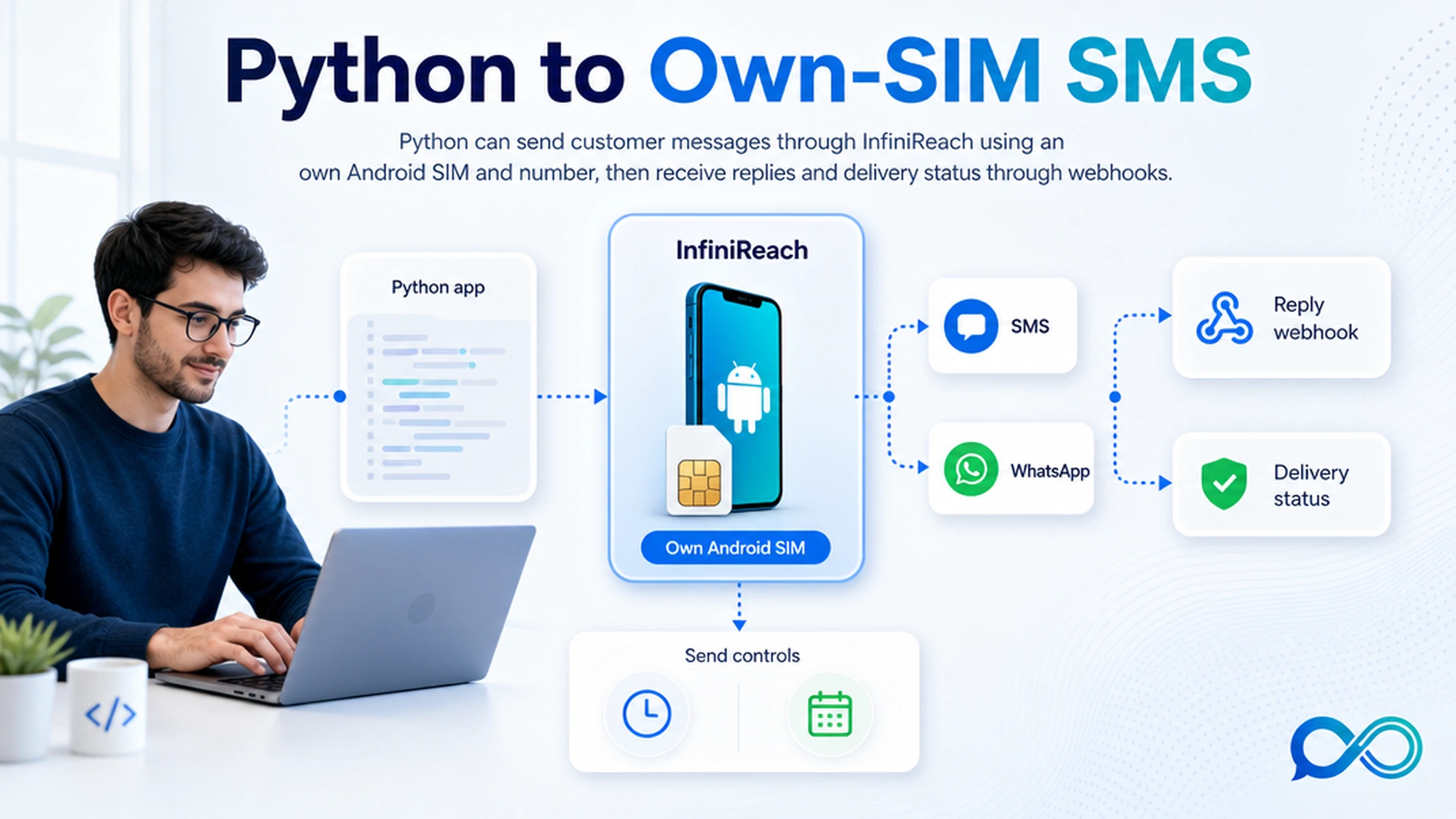
InfiniReach is the operating layer for that version of the problem. Your Python service keeps the business logic. InfiniReach handles the connected Android phone, own SIM sender, SMS or WhatsApp route, delivery tracking, replies, and webhook events.
key takeaways
Use this page if you want Python to run real messaging workflows, not just send one demo SMS.
- Send SMS from an Android phone, own SIM, and own number instead of defaulting to a rented sender.
- Call InfiniReach from Python with clear sender and channel fields so your code can choose SMS or WhatsApp.
- Use webhooks to bring replies and delivery status back into your app, CRM, or queue worker.
- Use send windows and daily SIM limits before a Python job moves from testing to recurring volume.
why developers search for a Python SMS API
The search intent is usually practical. A developer has a Flask app, Django app, script, worker, or internal tool that needs to send a text after something happens: a new lead, appointment reminder, failed payment, missed call, order update, or support handoff.
Twilio teaches the standard hosted-provider pattern well: install a Python helper library, buy or register a sender, then call the Messages API. Twilio also publishes United States long-code SMS pricing at $0.0083 outbound and $0.0083 inbound per segment, with notes about carrier fees, A2P 10DLC registration costs, and a $0.001 failed-message processing fee. That model is strong when you need broad CPaaS infrastructure. It is not the only model when the sender should be your own SIM and number.
where InfiniReach fits in a Python stack
Think of InfiniReach as the messaging transport behind your Python code. Your app decides who should receive a message, which number should send it, and what should happen after the reply. InfiniReach handles the connected device, channel route, message history, delivery state, and webhook events.
That keeps your Python code small. You do not have to build phone sync, SIM limits, WhatsApp routing, delivery history, and reply handling from scratch before a workflow can be useful to an agency or operator.
- Android relay app for SMS through your own SIM and number.
- Invite or QR flow for connecting devices and WhatsApp paths.
- API sending with explicit sender and channel control for SMS and WhatsApp.
- Webhook events for inbound replies and delivery status updates.
- Send windows and daily SIM limits to keep automated jobs under control.
a simple Python workflow pattern
The clean pattern has four parts: your trigger, the send request, the messaging route, and the webhook return path. A trigger might be a new CRM lead, a paid invoice, a missed call, or a nightly reminder job. Python sends the recipient, message, sender, and channel to InfiniReach. InfiniReach sends through the selected connected sender and reports what happened.
The reply path is what makes this more useful than a one-way script. When a customer answers, the webhook can update a record, pause a sequence, alert a human, or move the conversation into the CRM.
- Flask form submission → Python calls InfiniReach → SMS sends from the local business number.
- Inbound reply → webhook updates the lead and stops the automated follow-up branch.
- Delivery status changes → backend stores the result or retries through the approved path.
- Scheduled worker runs after hours → send window holds customer messages until the next allowed window.
a quick cost check before you choose the API
For a Python job that sends 8,000 United States long-code SMS segments in a month, Twilio public pricing at $0.0083 per outbound segment is $66.40 before number, carrier, registration, and other possible fees. If some messages fail, Twilio also lists a $0.001 failed-message processing fee for messages that terminate in a Failed status.
With InfiniReach, the point is different: use the phone plan and SIM you control, then pay for the software layer that gives Python API access, replies, webhooks, WhatsApp routing, and operator controls. You still need to price the mobile plan, consent rules, carrier terms, and InfiniReach plan. But your Python workflow is not automatically tied to a per-message platform fee for each segment.
compare common Python SMS API options
The right API depends on what you need after the first request works. Hosted CPaaS, phone-gateway tools, and InfiniReach solve different jobs.
- Hosted CPaaS: strong for global infrastructure, official sender programs, OTP scale, short codes, and large carrier-managed use cases; usually usage-metered and tied to provider sender setup.
- Raw phone gateway: useful for developers who want direct device control, but your team owns reliability, monitoring, UI, routing, and webhook glue.
- InfiniReach: better when a Python workflow needs own-SIM SMS, own-number sending, WhatsApp fallback, reply/status webhooks, send windows, daily SIM limits, and CRM-ready operations.
best-fit Python use cases
The strongest fit is workflow messaging where the sender matters. If the customer should recognize the number, or if replies should change what your system does next, own-number routing is worth testing early.
- Lead follow-up from a real business number after a form submission.
- Appointment reminders where replies confirm, reschedule, or ask for help.
- Missed-call text back tied to the same number the prospect just dialed.
- Agency client workflows where each client or location has its own sender.
- Backend alerts where SMS is primary and WhatsApp belongs in the same fallback plan.
when a hosted CPaaS is still the better choice
Do not use an own-SIM path as a shortcut around consent, carrier rules, or local messaging laws. InfiniReach gives you more control over the sender. It does not remove your responsibility to message people who asked to hear from you and to follow the rules that apply to your market.
A hosted CPaaS is still the better fit for some jobs: global OTP programs, short-code programs, complex carrier-approved sender portfolios, or teams that want every part of sender registration and telecom infrastructure managed by a large provider. InfiniReach is strongest when you want Python to use your own number, your own Android SIM, and CRM-ready reply handling.
next step: test one Python workflow end to end
Start with one workflow that has permissioned contacts and a clear reply path. Connect one Android phone and SIM, send a test message from Python through the InfiniReach API, then confirm that the delivery status and reply webhook land where your team works.
If that test needs own-number sending, SMS plus WhatsApp routing, and operator controls instead of another rented-number script, start free and price the workflow against your current message volume.