real SIM SMS gateway: the short answer
A real SIM SMS gateway sends through a SIM and phone number you control instead of only through a rented cloud sender. That matters when customers recognize the number, when replies need to land back in a CRM, and when agencies want phone-plan economics instead of per-message platform fees on every workflow.
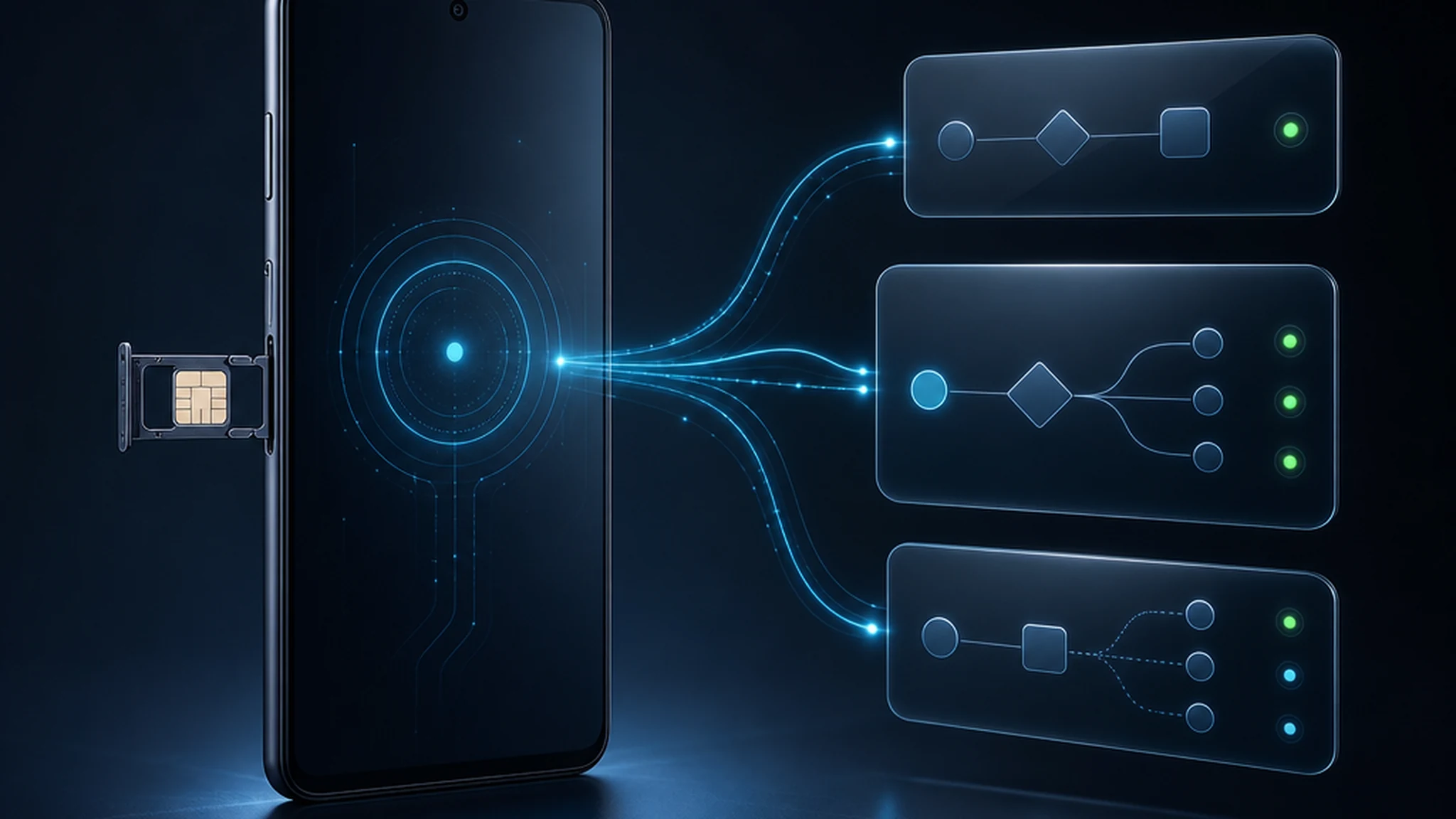
InfiniReach keeps that sender ownership but adds the operating layer most bare Android gateway apps miss: invite or QR onboarding, API `from` and `channel` control, reply and status webhooks, send windows, daily SIM limits, and routing for SMS/MMS, WhatsApp, and iMessage. SMS/MMS uses Android. iMessage uses a Mac signed into Messages with the InfiniReach iMessage Gateway app. It is not iPhone SMS relay.
key takeaways
Use this page if you are comparing Android gateway apps, hardware SIM boxes, and cloud SMS APIs for business messaging from a number you own.
- InfiniReach turns an Android phone and SIM into a CRM-ready SMS/MMS sender from your own number.
- The same messaging plan can route WhatsApp and Mac iMessage conversations where those channels fit.
- API requests can set the sender and channel explicitly with `from` and `channel` instead of hiding routing in one generic SMS action.
- Reply and delivery-status webhooks help GoHighLevel, n8n, Zapier, Make, Sheets, or a custom CRM react after the message sends.
- Send windows and daily SIM limits keep one real SIM from carrying more traffic than planned.
why teams search for a real SIM SMS gateway
The search intent is practical. Buyers are not asking for a definition of SMS. They are asking whether an Android phone, SIM, or hardware gateway can replace part of a Twilio-style route without losing automation, replies, or sender control.
Current search results show open-source Android gateway projects, Android SMS API products, hardware gateway comparisons, and forum threads about sending through a phone and receiving inbound messages by webhook. That mix tells you what buyers want: use the number they already have, trigger sends from software, and keep replies usable.
The weak version of this setup is a phone app that sends a text when an API call arrives. That may work for a lab project. A business or agency needs a fuller loop: selected sender, selected channel, message history, reply routing, delivery status, quiet-hour discipline, and a way to add more senders without turning the workflow into a pile of phones on a desk.
where InfiniReach fits in the gateway stack
InfiniReach sits between your CRM or automation tool and the sender. GoHighLevel, n8n, Zapier, Make, Sheets, or your backend decides that a message should send. InfiniReach receives the request, picks the sender and channel, records the message, and sends reply or status events back through webhooks.
For SMS/MMS, the sender is an Android phone with the client SIM. For WhatsApp, the route uses a connected WhatsApp session or device path. For iMessage, a Mac signed into Messages runs the InfiniReach iMessage Gateway app. Those paths are separate on purpose. It keeps SMS/MMS accurate, prevents false iPhone relay claims, and gives operators a clear channel map.
- Android relay app for SMS/MMS through a connected phone and SIM.
- Invite or QR onboarding for device and sender setup.
- API `from` and `channel` fields for sender and channel decisions.
- Webhook replies and delivery status events for CRM follow-up.
- Send windows and daily SIM limits before client volume grows.
comparison checklist: real SIM, cloud API, or hardware box
A real SIM gateway is not automatically better than every hosted SMS API. It is better when sender ownership, reply continuity, and predictable workflow economics matter more than buying a fully managed carrier route.
- Cloud SMS API: strong for managed telecom scale and formal carrier programs, but usually tied to rented or registered senders, usage pricing, carrier fees, and separate channel setup.
- Hardware SIM gateway: direct SIM control, but it can add appliance setup, port management, networking, firmware, office power, and support overhead.
- Basic Android gateway app: useful for simple API-to-phone sends, but often stops before CRM routing, agency sender maps, WhatsApp, Mac iMessage, or operational limits.
- InfiniReach: keeps the Android real-SIM sender and adds SMS/MMS, WhatsApp, Mac iMessage, API routing, webhooks, conversations, send windows, and daily SIM limits.
a worked cost test for one real sender
Price the workflow before you pick the gateway. Twilio publishes US long-code SMS at $0.0083 outbound and $0.0083 inbound per segment, before carrier fees and other line items. It also lists a $0.001 failed-message processing fee when a message ends in Failed status. US carrier fees can add more, such as published outbound SMS examples around $0.0035 for AT&T and $0.0045 for T-Mobile or Verizon.
Say one local client sends 12,000 outbound reminder and follow-up segments and receives 2,000 inbound replies in a month. At $0.0083 per segment, the base Twilio-style SMS line is 14,000 × $0.0083 = $116.20 before carrier fees, MMS, sender costs, failed-message fees, registration items, or agency support time. Add only $0.0035 to $0.0045 in outbound carrier fees and the 12,000 outbound segments add another $42 to $54.
The real-SIM question is different: can the client phone plan, the connected Android device, and the InfiniReach software plan carry that workflow with better margin and sender continuity? If yes, the agency can stop treating every automated follow-up as a tiny tax. If no, a hosted CPaaS route may still be the cleaner choice.
workflows that fit a real SIM gateway
Start with workflows where the sender is part of the customer experience. A real number helps when the recipient may reply, call back, recognize the business, or expect the same number across reminders and support.
- GoHighLevel lead follow-up from a client-owned number, with replies returned to the contact record.
- Appointment reminders where customers can reply to confirm, cancel, or ask a staff member for help.
- Missed-call text back from the same number the customer just dialed.
- Agency sub-account routing where each client keeps its own sender, limits, and reply path.
- Spreadsheet, n8n, Make, Zapier, or backend workflows that need SMS/MMS, WhatsApp, and iMessage options without separate tools for every channel.
controls to add before real volume
A real SIM is still a real sender. It needs rules. Consent, opt-out handling, local laws, carrier terms, message relevance, and customer expectations still apply. InfiniReach is not a compliance shortcut; it is an own-number operating path with controls around the sender.
Before you scale, decide which business owns the number, who answers replies, what hours the sender should run, and when a workflow should stop after a customer responds. Then set send windows and daily SIM limits so an import, retry loop, or campaign mistake does not overload one device.
- Keep one sender tied to one business, location, or client wherever possible.
- Route replies to a CRM record, shared inbox, automation branch, or human owner.
- Use send windows for local business hours and sensitive workflows.
- Set daily SIM limits before giving a workflow client-level volume.
- Log delivery status and replies so staff can see what happened after each send.
when a hosted provider is still the better fit
Do not use a real-SIM path just because it sounds cheaper. A hosted provider can be the better fit for global OTP, short-code programs, very high centralized throughput, formal telecom procurement, managed sender registration, or regions where your carrier plan does not permit the business use you need.
InfiniReach is strongest when you already have a permissioned audience, a real number customers know, and a workflow that needs replies, channel choice, and predictable sender economics. If the project depends on carrier-grade global coverage above all else, compare traditional CPaaS providers first.
a practical setup path
Start with one Android device, one SIM, and one workflow. Register the sender in InfiniReach, send a test API message with the intended `from` and `channel`, and confirm that replies and status events return to the system your team uses.
Then add channel routing deliberately. Keep SMS/MMS on Android. Add WhatsApp for contacts who belong on WhatsApp. Add the Mac iMessage gateway only where iMessage is part of the customer conversation. Once the full loop works, add send windows, daily SIM limits, and more client senders.
next step: test one real sender
Pick one workflow with permissioned contacts and a clear owner: reminders, missed-call text back, quote follow-up, review requests, or lead speed-to-contact. Connect the Android SIM, send from the real number, route replies back to the CRM, and measure the month against the metered API cost you would have paid.
If that test proves sender trust, reply control, and cleaner economics, expand the gateway map. If it does not, keep the hosted route for that workflow and use InfiniReach where own-number control actually changes the outcome.