fixed-cost SMS platform: the short answer
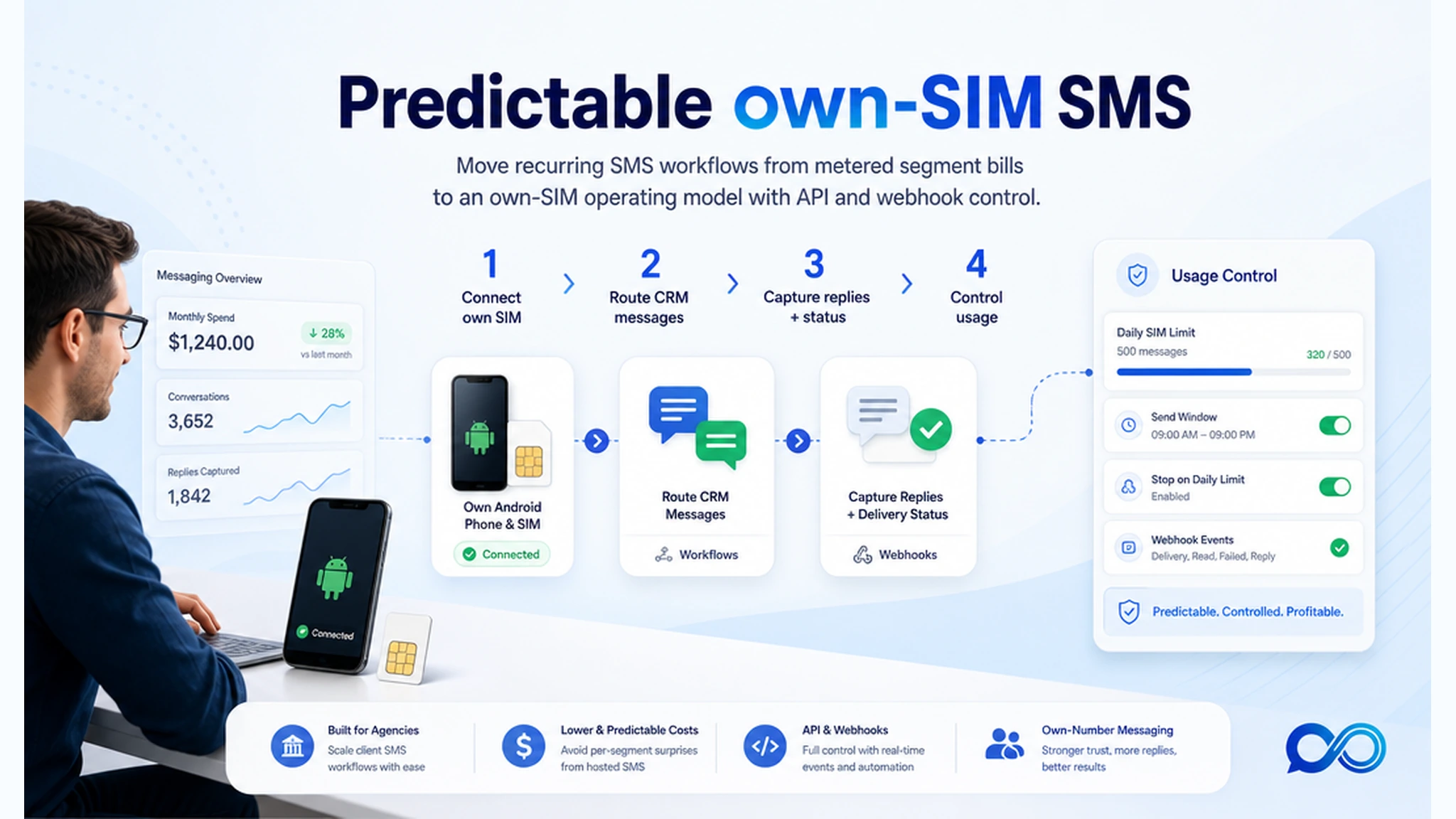
A fixed-cost SMS platform is worth considering when your team sends repeatable customer messages and wants the sender, replies, and budget under operator control. InfiniReach is built for that use case: connect an Android phone and SIM, send from a number you control, and route SMS plus WhatsApp through workflows instead of paying a platform fee for every segment forever.
This page is not arguing that every hosted SMS provider is bad. Provider-managed SMS is useful when you need short codes, global OTP scale, or formal carrier procurement. It is not automatically faster for local business messaging: A2P/10DLC registration, campaign review, sender approval, and account onboarding can add real lead time. InfiniReach fits a different buyer: agencies and operators that already have trusted numbers and want predictable software spend around their own sending path.
key takeaways
Use this page to decide whether one recurring SMS workflow should stay on a hosted, metered provider or move to an own-SIM InfiniReach setup.
- Metered SMS providers often bill by segment, with carrier, sender, number, and registration/onboarding costs layered on top.
- A2P/10DLC registration and campaign approval can also add setup time, so “hosted” does not always mean faster to launch for agency workflows.
- InfiniReach changes the model by using an Android relay app, your own SIM, your own number, explicit API from/channel routing, and webhook replies/status.
- Fixed-cost friendly does not mean unlimited or compliance-free. You still manage consent, carrier rules, send windows, and daily SIM limits.
why teams search for fixed-cost SMS platforms
The search intent is usually budget pain, not curiosity. A team starts with a hosted SMS API because it looks simple on paper. Then registration, sender setup, carrier rules, reminders, lead follow-up, review requests, payment nudges, and support replies become part of the operating cost. Suddenly the SMS line item and launch timeline are harder to control.
For agencies, the problem is sharper. One client might have low volume. Another might run appointment reminders, missed-call text back, and reactivation campaigns at the same time. If every workflow is billed by segment, margin depends on message volume you do not always control.
InfiniReach answers that pressure by moving the transport closer to the operator. The workflow still has API access and CRM automation, but the sender can be a real Android phone and SIM rather than only a rented hosted number.
public pricing benchmarks to know
Public pricing pages make the metered model clear. Hosted SMS is commonly priced per outbound and inbound segment, with carrier fees, sender fees, number fees, and registration or campaign costs depending on the route and country.
The cost issue is not only the per-message rate. For US A2P/10DLC-style sending, teams may also deal with brand registration, campaign vetting, sender setup, monthly campaign fees, and approval delays before messages can run the way a client expects.
Those numbers are not scary by themselves. They become hard to plan when one workflow turns into ten workflows, replies are counted too, and a client expects the agency to absorb messaging variance inside a fixed retainer.
worked example: a monthly follow-up workflow
Say an agency runs follow-up for one busy local client. The workflow sends 10,000 outbound SMS segments in a month and receives 1,000 inbound reply segments. Even at less than one cent per segment, the segment portion alone can approach the low hundreds before carrier fees, phone number costs, registration overhead, campaign fees, and any other platform costs.
At low volume, that may be fine. At agency volume, the same pattern across ten client accounts is no longer a tiny line item. It is a usage bill that moves with every campaign, reminder sequence, missed call, and reply.
With InfiniReach, the team can test whether that workflow is a better fit for an owned SIM path. The client’s own number can send through a connected Android device, while the CRM still uses API calls, webhooks, status events, send windows, and daily SIM limits. The budget discussion shifts from “how many segments did we burn?” to “which devices, numbers, and workflows should this operator run?”
where InfiniReach fits in the stack
InfiniReach sits between your workflow tools and the messaging channels. Your CRM, GoHighLevel account, Zapier flow, n8n workflow, Make scenario, or custom app decides when a message should go out. InfiniReach handles the sender path, channel routing, reply capture, and delivery/status events.
The product mechanisms are concrete. SMS relay uses an Android app and a connected SIM. Device and WhatsApp setup can use invite or QR onboarding. API sends can include explicit from and channel fields. Webhooks can bring replies and delivery status back into the system that started the workflow.
- Own Android phone and SIM for SMS from a number the business controls.
- SMS plus WhatsApp routing when the workflow needs more than one channel.
- POST /api/v1/messages style sending with explicit sender and channel decisions.
- Webhook replies/status so inbound messages are not trapped on the phone.
- Send windows and daily SIM limits to keep usage disciplined.
metered API vs own-SIM fixed-cost model
The real comparison is not “cheap versus expensive.” It is about which cost model matches the workflow. Metered APIs are clean for developer teams that want a hosted telecom layer. Own-SIM messaging is better when sender ownership, reply continuity, and recurring client workflows matter more than outsourcing every part of delivery.
- Hosted metered SMS: provider-managed infrastructure, billed per segment, and often tied to rented or registered sender paths; launch speed depends on sender registration, campaign approval, and account review.
- InfiniReach: uses a connected Android phone/SIM for SMS, keeps the business number in play, and gives workflows API plus webhook control.
- Hosted metered SMS: strong for global OTP, broad carrier coverage, and programs that genuinely need provider-managed telecom infrastructure.
- InfiniReach: strong for agencies and operators that already own the sender relationship and want SMS plus WhatsApp in one CRM-ready stack.
best-fit workflows for fixed-cost SMS
The best candidates are recurring workflows with known recipients, clear consent, and a real reply path. Start there before moving large campaigns or sensitive messages.
- Appointment reminders where customers recognize the local number and may reply.
- Lead follow-up from GoHighLevel or another CRM where speed and reply routing matter.
- Missed-call text back for local service businesses that already advertise one number.
- Reactivation or review-request workflows where the agency wants margin control.
- Operational alerts that should be logged with delivery status and message history.
when not to use InfiniReach for SMS cost control
Do not choose InfiniReach just to dodge rules or blast cold lists. The own-SIM path still needs consent, carrier acceptable-use discipline, and local legal review. It also requires an Android device for SMS relay, which means your team owns part of the operational setup.
A hosted provider may be the better choice when you need global OTP delivery, short codes, large-scale telecom procurement, or a program where sender registration and carrier relationships must stay fully inside a provider-managed stack. That is a procurement and coverage decision, not a guarantee of faster setup.
how to test one workflow before switching
Pick one repeatable workflow with real volume and clear permission: appointment reminders, lead follow-up, missed-call text back, or payment nudges. Pull the last 30 days of segments, replies, number fees, and registration costs from your current provider. Then price the same workflow as an InfiniReach own-SIM setup with the devices, SIM plans, and software tier you actually need.
The right answer should be obvious after that test. If the workflow depends on hosted global reach or short-code/OTP infrastructure, keep it on a hosted provider. If it depends on a local number, two-way replies, CRM routing, faster practical launch, and predictable agency margin, move it behind InfiniReach and measure the next month.
next step: price one real workflow
Do not start with a platform-wide migration. Start with one workflow and one sender. Connect an Android phone and SIM, route the CRM or automation through InfiniReach, confirm replies and delivery status return through webhooks, then compare the monthly cost against your current segment bill.
If that first workflow proves the economics, expand sender by sender instead of guessing from a spreadsheet.