key takeaways
This page is for GoHighLevel agencies deciding whether LC Phone should carry every SMS workflow, or whether selected client workflows belong on an own-SIM messaging path.
- HighLevel support docs describe LC Phone pricing around phone numbers, SMS/MMS segments, carrier pass-through fees, voice, and A2P registration items.
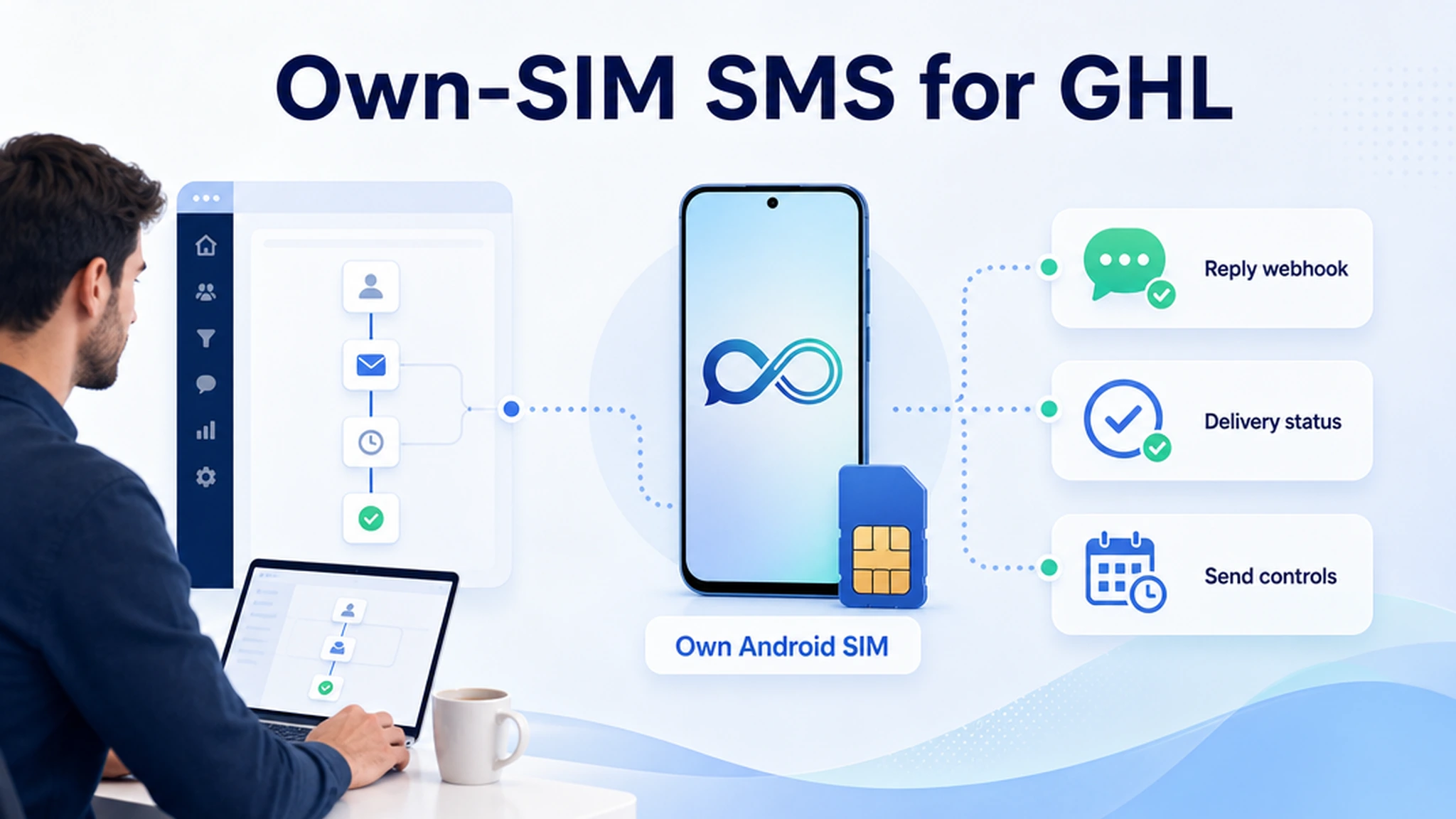
- InfiniReach lets selected GoHighLevel workflows send through a connected Android phone, SIM, and business number the client controls.
- The useful mechanisms are practical: API `from` and `channel`, reply/status webhooks, send windows, daily SIM limits, and SMS plus WhatsApp routing.
- A hosted CPaaS path can still win for OTP, short codes, or global telecom programs. InfiniReach fits agency workflows where sender ownership and margin matter.
why agencies look for an LC Phone alternative
Most agencies do not search for an LC Phone alternative because they hate HighLevel. They search because LC Phone is convenient until SMS becomes a margin line. A missed-call text back here, a review request there, a reactivation sequence for ten locations, and suddenly every client workflow creates another usage-funded bill.
The decision is operational. Which number should send? Where do replies go? What happens when a client wants WhatsApp for some conversations and SMS for others? Can one sender be limited before a campaign pushes too much volume through it? LC Phone is a native hosted path. InfiniReach is an own-number path for workflows where the agency wants more sender control.
the LC Phone cost drivers to model first
HighLevel's current support docs say Phone System pricing includes phone number rental, SMS/MMS messaging, voice calling, carrier pass-through charges, and A2P registration. The same docs list US/Canada local numbers at $1.15 per month, US/Canada SMS at $0.00747 per segment, and carrier fees on top of base SMS rates. Another HighLevel A2P fees article lists one-time brand/campaign fees such as $24.49875 for Sole Proprietor or Low Volume Standard and $71.90625 for High Volume Standard, plus monthly campaign fees such as $2, $10, or $1.50 depending on use case.
Twilio's own US SMS pricing page is a useful public benchmark because LC Phone is described by HighLevel as matching Twilio rates. Twilio lists US long-code SMS at $0.0083 outbound and $0.0083 inbound per segment, and its pricing notes mention carrier fees, A2P onboarding fees, and a $0.001 failed-message processing fee. Rates can change, so the point is not to freeze a perfect number. The point is to model every moving part before you scale.
a worked monthly example for one GHL sub-account
Take one local-service client using GoHighLevel for missed-call text back, appointment reminders, and review requests. In a month, assume 12,000 outbound one-segment SMS and 2,000 inbound reply segments. At Twilio's $0.0083 benchmark, base SMS math is 14,000 × $0.0083 = $116.20 before phone number rental, carrier fees, A2P items, MMS, failed-message fees, or agency rebilling work.
Using HighLevel's $0.00747 base rate for the outbound portion, 12,000 outbound segments are $89.64 before inbound replies and carrier pass-through fees. Add a common outbound carrier-fee range shown in HighLevel docs, such as $0.0035 to $0.0050 per segment, and those 12,000 outbound segments add roughly $42 to $60 more. That is still before the customer replies.
With InfiniReach, the agency compares that variable bill against an own-SIM setup: the client phone plan, the connected Android device, and the InfiniReach software plan. The current public pricing page lists Starter at $37/month with 2 SIM cards and Pro at $97/month with up to 10 SIMs. That does not make carrier or consent work disappear. It gives the agency a cleaner fixed-software-cost test for workflows that fit an owned sender.
- Count segments, not just messages.
- Count inbound replies because two-way workflows create usage too.
- Add number rental, carrier fees, campaign fees, failed-message fees, and client rebilling time.
- Compare one real client workflow against phone plan plus InfiniReach plan cost.
where InfiniReach fits beside LC Phone
InfiniReach does not replace GoHighLevel as the CRM. GoHighLevel still keeps contacts, pipelines, calendars, triggers, and staff tasks. InfiniReach sits under selected workflows as the messaging transport and control layer: connected Android SIM, sender choice, channel choice, message history, replies, delivery status, and usage controls.
For SMS, the current path uses an Android relay app. The device is registered through an invite or QR flow, then messages can send through the connected SIM. For API and automation use, InfiniReach can accept explicit `from` and `channel` values, so a workflow can choose which number sends and whether the route is SMS or WhatsApp where relevant.
- Own Android phone and SIM for client-owned SMS sending.
- API `from` and `channel` control for sender and route selection.
- Reply and delivery status webhooks for CRM or workflow logic.
- Send windows and daily SIM limits before client volume grows.
- SMS plus WhatsApp in one messaging layer instead of a separate fallback tool.
comparison checklist: LC Phone vs own-SIM InfiniReach
This is not a generic “which is cheaper?” choice. LC Phone is a native hosted phone system. InfiniReach is better when the agency wants an owned sender and operational controls for specific workflows.
- Sender model: LC Phone uses HighLevel's hosted phone infrastructure; InfiniReach can use a connected client-owned Android SIM and number.
- Cost behavior: LC Phone follows segments, phone numbers, carrier fees, and A2P items; InfiniReach shifts eligible workflows toward phone-plan plus software economics.
- Reply path: both can support conversation workflows, but InfiniReach also exposes reply/status events through webhooks for custom CRM or automation routing.
- Channel coverage: LC Phone is the default phone/SMS path; InfiniReach keeps own-SIM SMS and WhatsApp close to the same workflow layer.
- Controls: InfiniReach adds sender maps, send windows, daily SIM limits, and API channel control around the connected device path.
GoHighLevel workflows that fit the own-SIM path
Start with workflows where the sender relationship changes the outcome. If a lead called a local office, a reply from that same known number may be worth more than another generic sender path. If a client is paying the agency to protect margin, predictable software-led costs matter too.
- Missed-call text back from the number the lead just dialed.
- Appointment reminders where replies should confirm, reschedule, or alert staff.
- Review requests after a job, visit, or appointment from a client-owned number.
- Reactivation campaigns that need send windows and daily SIM limits.
- WhatsApp-first follow-up with owned-SIM SMS backup when a channel is not a fit.
when LC Phone or another hosted provider still wins
Stay with LC Phone, Twilio, or another hosted CPaaS when you need managed global coverage, OTP, dedicated short codes, high centralized throughput, carrier-contract programs, or one native phone system for all clients with no device operations. Those are valid reasons to keep a hosted path.
Some agencies also compare own-SIM routes because hosted A2P registration, campaign review, sender approval, or carrier rules slow down a client launch. Keep the language honest. An own-SIM workflow can reduce reliance on a hosted A2P sender path for selected use cases, but it is not a no-rules shortcut. Consent, opt-out handling, quiet hours, relevant content, carrier-safe volume, and local rules still matter.
Choose InfiniReach when the workflow benefits from a number the client controls, SMS plus WhatsApp routing, reply/status automation, send windows, daily SIM limits, and a cost model your agency can explain before volume grows.
a practical migration path for one client
Do not move every GoHighLevel workflow at once. Pick one client, one sender, and one workflow with visible value. A missed-call text back or appointment reminder is a good test because you can confirm outbound delivery, inbound reply handling, and staff handoff quickly.
- Connect the Android phone and SIM to InfiniReach with the invite or QR flow.
- Map the GHL trigger, sender number, channel, reply destination, and fallback rule.
- Send a live test through the chosen own number and confirm status and reply webhooks.
- Add send windows and daily SIM limits before any campaign or reactivation batch.
- Compare the first month against the LC Phone usage bill before moving more workflows.
next step: price one LC Phone workflow
Pick one active GoHighLevel workflow and write down five numbers: outbound segments, expected replies, sender count, current LC Phone fees, and client margin target. Then compare that usage model against an InfiniReach own-SIM setup with the phone plan and software plan included.
If the workflow needs a known sender, reply handling, SMS plus WhatsApp routing, and fewer usage surprises, start with pricing or book a demo to map that one workflow before touching the rest of the sub-account.